
Soft Generic Polls, But Hard Blue Turnout
Midterm Democratic Turnout Should End One-Man Rule


Democrats are fretting over soft midterm House generic ballot numbers. Even in the face of Donald Trump’s caving approvals, their edge is sitting anywhere from a very narrow D+2 to D+6 with a few outliers – well below expectations. Nate Silver even just cautioned about a slight drop to D+6.1 in his Democratic generic polling averages.
But here’s what reminded me that generic ballot polling at this point is measuring the wrong electorate. Recent national Washington Post/Ipsos polling cuts straight to the real midterm fault line – turnout. And that’s detailed below.
As midterms approach, pollsters will focus more on likely voters – a more realistic target in low turnout midterms. At this point it’s just registered voters, whether they will get off their couches or not.
Turnout, Turnout, Turnout
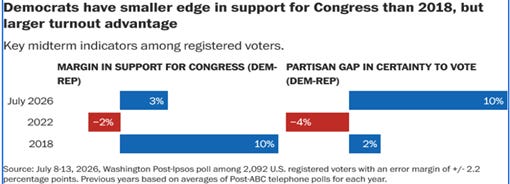
Even as Donald Trump frantically yanks or threatens to yank every lever he can reach to twist the midterms his way, turnout remains the central battlefield of midterm elections — structurally, historically, and empirically. His House margin sits at a narrow +3, not much for Democrats to flip control.
Importantly, Democrats see their enthusiasm and turnout advantage growing ahead of midterms, while Republicans see enthusiasm sinking – described by some GOP operatives as “scary.”
Democrats Intensity Edge
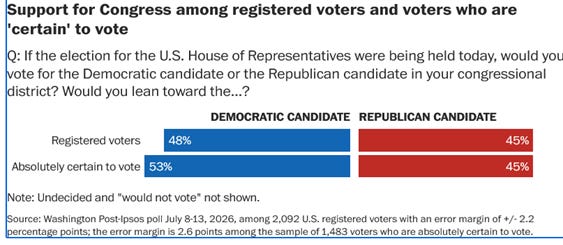
Here’s the tell. Washington Post polling finds that the Democratic edge jumps from a thin three point margin, 48%-45% -- the “generic vote” -- to eight points among voters who say they’re “absolutely certain to vote: 53% backing Democrats, 45% backing Republicans. A slim lead becomes a turnout‑powered surge – if the Democrats can keep their base fired up. And the eight point margin resembles the 2018 Democratic midterm blowout, yielding a net 40-seat gain.
Here’s another take on the Democratic turnout advantage. That same Washington Post poll finds that Democrats are showing a far stronger commitment to vote than Republicans — and by a much wider margin than in 2018. Democrats are 10 points more likely to say they’re certain to vote this year, compared with just a 2‑point edge at this same stage in 2018.
More than seven in ten Democrats say voting in 2026 is more important than in past midterms, while only about half of Republicans say the same.
And when Verasight polling filtered their monthly polling data to the people who say they’ll definitely or probably vote in November, the Democratic Party’s lead grows to almost 9 points — a boost of about a point and a half on average across their polls.
Add Actual Off-Year Democratic Overperformance
For poll skeptics perhaps the best indicator of Democrats turnout advantage is the party’s overperformance – the shift from the 2024 presidential baseline toward the Democrats -- in recent off-year elections.
Election analyst G. Elliot Morrison found that off-year election turnout was responsible for anywhere between 25% and 40% of the gains the Democrats have made since the 2024 election. His tracking of non-partisan Downballot data found Democrats running ahead of Kamala Harris’s 2024 vote margin by about 12 points in state legislative and congressional special elections. As an example:
In Donald Trump’s Florida House district 87, which includes Mar-A-Lago, Democrats flipped the district that Trump won by 11 points in 2024.
Midterm Turnout Dynamics
The midterm turnout problem is stark for both parties: people have to feel voting is worth it, and midterms rarely spark that fire. Sparking the fire has become even more difficult with both parties in the political doghouse. But advantage Democrats here.
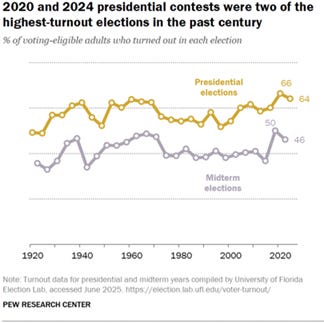
Here’s a history of election turnout revealing the drop-off in midterm turnout, demonstrating that off-year midterms often redesign the presidential electorate.
Generic Polling Now Off-Kilter
National generic ballot polling is supposed to be the midterm weathervane — a clean, national read on which way the wind is blowing. Generic ballot polling today does give the Democrats a slight edge. But that edge is too soft, too inconsistent, and too disconnected from the real driver of modern midterms: turnout.
In 2018 – the last blue wave -- the generic ballot and the actual midterm results moved in lockstep — a D+7.3 generic ballot edge and a Democratic turnout surge that produced a near‑perfect D+8.4 House popular vote netting 40 House seats. The instrument was calibrated.
By historic generic polling standards – now questionable -- Democrats should be staring at a 2018‑style sweep. The fundamentals should point that way, The “midterm penalty” points that way. Trump’s historic low job approval rating points that way. Midterm vote should also correlate to the now deeply underwater issues that fueled Trump’s reelection -- affordability and immigration. The raging Iran war, ICE brutality and the Epstein files further undermine Trump’s standing. Yet the generic ballot isn’t fully reflecting — or isn’t reflecting consistently — the full extent of Trump’s fractured presidency.
Turnout: the Real 2026 Fault Line
Today, registered voter 2026 generic polling is misaligned with the real midterm electorate because:
· Democratic turnout is increasingly driven by high‑propensity voters (college‑educated, suburban, issue‑activated) who are already registered and already engaged.
· Republican turnout is increasingly driven by low‑propensity voters (rural, non‑college, evangelical) who vote mainly in presidential elections and when Trump is on the ballot.
· Trump’s 2024 coalition has splintered, with many non-MAGA Republicans reporting low enthusiasm for midterm voting even if they respond to the generic polling.
· Issue‑driven mobilization (abortion, democracy, health care) doesn’t show up cleanly in registered voter generic ballot polling.
In short, the generic ballot — at this stage — is measuring the registered electorate, not the midterm electorate. They have very different profiles.
Presidents’ “Midterm Penalty”
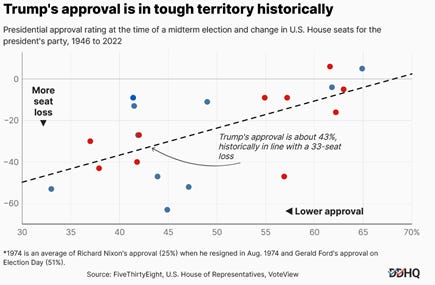
Republicans are running straight into the built in “midterm penalty.” Sitting presidents always take a beating in the House during midterms, but the size of that beating historically tracks one thing above all: how the country feels about the president. History demonstrates that when approval tanks, seat losses spike. (See HQ Decision Desk below.)
With Trump’s approval rating currently sitting somewhere between low to high thirties and disapproval somewhere in the low sixties, we would expect a near earthquake for the House Democrats. After all, in Trump’s first term 2018 midterms Democrats took 40 House seats. Trump’s approval heading into the 2018 midterms sat in the low 40s, with most high‑quality polls clustering around 40–41% approval. In the 2018 generic congressional ballot polling, Democrats held a consistent and sizable lead. The RealClearPolitics final average showed Democrats +7.3 (49.7% D / 42.4% R).
Decision Desk HQ estimated earlier in this year that with Trump’s approval rating in the low 40s at the time, history predicts a gain of at least +30 seats. That’s not likely because of GOP mid-decade gerrymandering, handing them maybe a nine or ten GOP seat bonus. Also, Cook Political Report finds only 18 current House seats are toss-ups, though other seats are only “likely” Republican or Democratic.
Here’s the Decision Desk’s mapping of midterm presidential approval and lost seats
More Lessons from 2018 Democratic House Sweep
Analysts seek parallels to the Democrats 2018 House sweep – gaining 40 seats. The lesson was brutally simple. When your voters show up, you win. When they don’t, you don’t. And they showed up in 2018 in record midterm numbers. And turnout set a record in 2018: 50%
Pew’s validated voter study makes it unmistakable: Democrats expanded their electorate.
They mobilized 2016 nonvoters, boosted turnout among their base, and cut into GOP margins with younger white voters and college‑educated suburban voters.
And they rode a year‑long generic ballot lead that signaled national mood and powered the 41‑seat House flip.
Health care was a driving issue.
The core takeaway is this: 2018 wasn’t magic — it was math. Enthusiasm + turnout + a steady generic ballot advantage -- a midterm House earthquake.
2026: Trump Voters Hitting the Snooze Button
Looking under the hood, three related factors are causing GOP concern:
First, the Republican 2024 coalition is fraying. While MAGAs mostly remain loyal to Trump if not his policy choices, non-MAGA Republicans, about a third of Republicans, increasingly mirror independents rather than party stalwarts.
A mid-May Economist/YouGov poll, reveals that only 18% of self-identified MAGA loyalists thought the economy was worsening, compared to 65% of non-MAGA Republicans. This massive rift effectively aligns non-MAGA voters with independents, 67% of whom voiced pessimism about the economy.
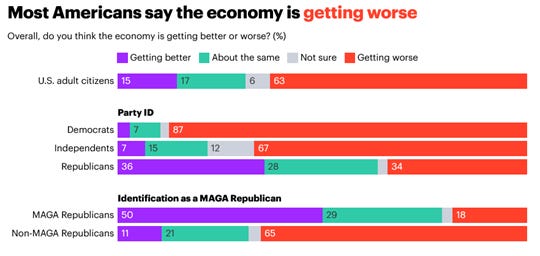

Second, Trump’s 2024 base contained many low propensity voters who vote infrequently and are much less engaged. While some may defect, particularly as the economy sours, a meaningful chunk of Trump’s 2024 voters – about one-third of his 2024 supporters -- are at risk of just sitting out 2026. Midterms historically bleed low‑propensity voters.
These low propensity voters who helped power Donald Trump’s 2024 victory—disproportionately young men, working-class voters without college degrees, lower-income households, and Hispanic/minority men—are also notoriously difficult to mobilize when Trump himself is not on the top of the ballot. Political analysts often refer to this dynamic as the “Trump Turnout Penalty” or the “Midterm Mirage”.
Economic pain was their main driver. AP VoteCast found that economically dissatisfied voters, especially those who vote inconsistently, broke toward Trump. But today, a large majority of all voters give Trump low marks on his handling of the economy— a fracture line likely running straight through his low‑propensity base.
Third, Trump has bled support among independents. He won 52% of independents in 2024. Recent PRRI polling finds him at a 25% approval level.
Moreover, polls find that while 81 percent of Republicans overall approve of Trump’s job performance, that drops to 52 percent among Republican-leaning independents.
But Wait!
The story doesn’t end there. Republican and Trump‑aligned maneuvers — mid‑decade reapportionment pushes, efforts to slash mail voting, talk of deploying ICE agents near Democratic precincts — combined with Democrats’ trademark strategic clumsiness could flip the script fast.
We don’t know what other machinations Trump is planning to seize control of the election. His conspiracy theory-ridden speech last week, his so-called SAVE American Act to take federal control of elections and pretty-much eliminate mail balloting, threats to deploy the military at Democratic precincts, his cries of “communism, and his “election integrity crisis” may function as a pretext to tighten his partisan control over how elections are run. His pattern is familiar: declare the system broken, insist only he can fix it, and frame oversight changes as emergency repairs rather than political power grabs that tilt the election his way.
Whatever is in Trump’s playbook, neither party’s performance in Congress is earning high marks. Approval is soft across the board, with voters expressing frustration at both Democratic and Republican leadership — a bipartisan confidence problem that shows up in every major survey.
In Sum
As midterms come into view less than 100 days away, pundits and politicians offer no end of speculation about whether we’re nearing an end to one-man rule in Washington. If midterms are mostly a referendum on the sitting president, then advantage Democrats. But Republican/Trump machinations, such as mid-decade reapportionment, Trump’s efforts to eliminate most mail balloting, and ICE agents at Democratic precincts can change the election’s direction. Then there’s the progressive energy among some Democrats that swing voters can read as too radical and Democrats’ usual political ineptitude.
At this point, the highly respected Cook Political Report cautions that, even on a good night, Democrats “will produce a relatively slim majority” and a “GOP path remains.” Mid-decade GOP gerrymandering provides a nine-or ten-seat cushion. Most House districts are considered “safe” for the incumbent party. But what’s clear at the moment is that turnout will be decisive. Democrats have the edge. And the current generic ballot, long the midterm political weathervane, is no longer a reliable predictor of seats gained or lost.
###
Thank you for your insightful essay summarizing current polling. It is a safe bet that with their large monetary advantage going into the midterms, the Republicans will saturate the airways with: “open borders” -crime and taking your jobs, “defund the police”- and resultant chaos in the streets, “open the prisons”- with robberies, rapes and pandemonium, the “trans” takeover of society, government, and school boards, godless communism shutting down places of worship, on and on. The deluge of these images on the “low propensity” voter may scare them enough to indeed, get them off their couches and vote in November.
Hopefully, Trump's machinations will be ineffective and a turn-off to many voters! Here's hoping............. Thanks, Mark.........