
Does U.S. Need A King?
Royal’s Speech More in Sync With Americans Than Are Our Own Lawmakers

White House Posting: “TWO KINGS”
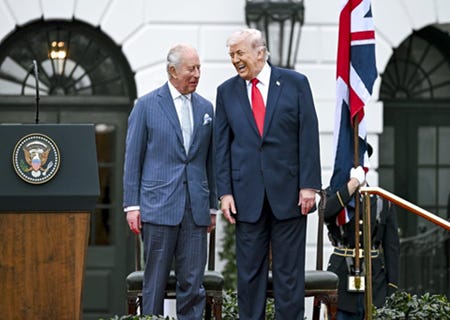
Do we need a king in America? No, not that king! A real king. In this 250th anniversary, can we amend the Constitution to extend the British monarch’s reign to America?
Granted, polling finds most Americans (62%) reject the U.S. having a monarchy of its own, let alone a Brit with crown. With few exceptions, most Americans view the British royals as celebrities, not serious players. And the Magna Carta, which limits monarchical power and sealed in 1215, is a just subject in high school history class, not a living document, right?
Crowning Achievement!
But Tuesday’s speech to Congress by King Charles forced us naysayers to rethink. In a highly polarized country where we’re dubious of royals and where we can’t agree on who won the 2020 election, King Charles managed something rare in Washington: he gave Congressional Democrats and Republicans – even the staunchest MAGAs -- a chance to applaud, sometimes even standing -- on many of the same issue positions at the same time – a rarity.
By contrast, standing up during the President’s State of the Union address is usually a signal to the cameras that you’re on the “right team.” Staying seated is a silent protest.
And on key issues he touched – checks and balances, transatlantic relations, NATO, Ukraine – the King, who ascended to the throne by accident of birth, was more aligned with a majority of Americans than is our elected president – even in our highly polarized society. Overall, we rediscovered that maybe Americans are less divided than our politicians and our media tell us.
Crowning Issues
Let’s review the issues King Charles referenced with both clarity and humor, never mentioning Trump by name:
1. Checks and Balances
King Charles reminded lawmakers that executive power “subject to checks and balances” was a British legal tradition, enshrined in the Magna Carta, and which carried over as a bedrock principle of the American Constitution. Yea, Congress does need reminding, having largely abdicated its role. Cheers started on the Democratic side of the chamber before spreading across the entire room.
Most Americans hold “checks and balances” to be a core tenet of the Constitution. But one that is failing in the Trump presidency – a prime motivator of the “No Kings” rallies.
Pew polling found in 2017 that 87% of Americans say it is very important that the president be subject to checks and balances, including 84% of Republicans and 90% of Democrats.
A February 2025 Pew poll found that 78% of U.S. adults believe it would be “too risky” to give presidents more power to deal directly with the country’s problems, preferring instead that they remain constrained by Congress and the courts.
But now nearly seven in ten Americans (68%), up from 56% last year, say the system of checks and balances is not working well, according to a January 2026 PBS News/NPR\Marist poll. That’s up from 56% just last year. Slightly fewer than one in three (32%) strongly agree or agree that the system is functioning well.
The largest change has occurred among Republicans and independents: 43% of Republicans, up from 26%, and 75% of independents, up from 64%, think the system of checks and balances in the U.S. is not functioning effectively.
2. Deteriorated Transatlantic/NATO Relations
Charles referenced current diplomatic strains, including disagreements over Iran and Ukraine, and American’s deteriorating NATO role. He explicitly praised NATO. This was widely read as a counterpoint to Trump’s criticisms of NATO and a need to reaffirm transatlantic security commitments.
Trump has called Europe “decaying,” describing some European leaders as “stupid,” and joking about France’s president in personal terms. He has termed NATO a “paper tiger.” And in special jabs at Britain, Trump has repeatedly mocked the British Royal Navy, most notably calling its aircraft carriers “toys” and claiming the UK “doesn’t even have a navy.”
Quoting former US Secretary of State Henry Kissinger, the King spoke of the Atlantic partnership and reminded Americans that the only time NATO mobilized in defense of one of its member-states was after the 9/11 terror attacks by al-Qaeda.
While NATO has become a partisan punching bag in Congress, the King’s comments once again reflected American public support for NATO, which has slipped in recent years but remains steadfast. A Pew survey last month found a majority of Americans, 57%, have a favorable view of NATO, even with a wide partisan divide.
Republicans are much less likely than Democrats to express a favorable view of the alliance (42% vs. 75%).
A majority of independents (57%) support NATO.
The Pew survey also finds that most Americans (63%) are not confident that Trump “can make good decisions when it comes to working effectively with NATO.” Again, a steep partisan divide emerges.
About six in ten Republicans (62%) express confidence compared to 11% of Democrats.
3. Support for Ukraine
And then there was Ukraine. Charles’ tribute to “the courage of the Ukrainian people” drew applause because it aligned with a gut feeling most Americans still share, even if Congress remains deadlocked on Ukraine support. Trump has repeatedly mistakenly suggested Ukraine provoked the conflict or brought the war on itself. He has halted direct U.S. military aid to Ukraine, shifting support toward indirect or conditional assistance. His negotiation‑first plan tracks closely with Putin’s red lines.
Most public polling finds continued support for Ukraine, reflected by the King and at odds with Trump’s policies. The December 2025 Reagan National Defense Survey reported a broad, bipartisan majority supports Ukraine’s victory and continued U.S. weapons aid:
62% want Ukraine to prevail over Russia.
64% support sending U.S. weapons to Ukraine (up 9 points from the prior year).
70% say they do not trust Russia to honor any peace agreement.
In Sum
So no, King Charles didn’t magically unify the United States. But in one afternoon speaking to Congress, he reminded Congress — and the country — that beneath the partisan noise, most Americans still agree on the fundamentals. They believe in constitutional limits. They believe alliances matter. And they believe aggression shouldn’t go unanswered.
We’re in a time when the President of the United States has labeled Democrats as people he “hates,” “can’t stand,” and even as “the enemy from within.” Just yesterday in testimony before the House Armed Services Committee, Secretary of Defense Pete Hegseth called Democrats “the biggest adversary we face.”
The King’s visit underscored that we lack a shared national neutral reference point — someone all sides can acknowledge without treating opponents as an enemy. I’m not about to become an advocate for an American royale. But I do understand better now why a large majority of Brits (58%) prefer keeping the monarchy over replacing it with an elected head of state.
###
Born a "subject" of the Queen, I was a bit tough on the new King till this address. Talk about diplomacy. Our politicians have much to learn. Our citizens have much to learn about not just US history, but of the World.
Being raised by a German mother and a Ukrainian father with the history of WWII in their lives, history and current events was part of the daily conversation. Sadly, that is not the case in the US, even with many of our elected leaders, and it shows.
Excellent commentary. It was a joy to hear a leader with "class" address our lawmakers. It has been missing for too long. The reference to the magna carta was brilliant as was the reference to Ukraine. Just recently, top Republicans spoke up in opposition to Trump taking 5,000 troops out of Germany. Maybe, Charles inserted some spine into the GOP.