
Rescue Mission to Reel Back “Bros”
Trump’s Cage Wrestling Circus on the White House Lawn

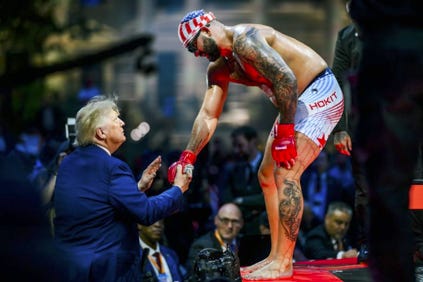
Masculinity is a key pillar of Trump’s brand. But what does a sleepy octogenarian do when he wakes up to find that two key pillars of his 2024 “manosphere” base are slipping — that is, men in general, but particularly young men, who have all but deserted him? Trump’s answer: crank up his 2024 “manosphere” strategy, particularly the cage fight spectacles from 2024 – this time on the White House lawn.
Men powered Trump’s 2024 winning coalition. Men backed Trump, women backed Harris — with roughly a 10‑point gap between them. In 2020, Trump took the male vote by just 2 points, 50%-48%.
When Trump took office in January 2025, major pollsters like Gallup and Marquette Law registered his initial job approval at 47% to 48%. But his approval numbers among men have drifted down into the low 40s, even lower in some polling. Young men in spring Harvard Youth Poll are down much lower.
Republicans still hold a lead among men in the generic congressional balloting, even as Trump’s numbers slip. But, as will be documented, the greatest falloff according to the generic Congressional balloting has been among younger males.
UFC Strategy Redux
Trump’s 2024 male‑voter strategy was simple and aggressive: lean into toughness, rebellion, and anti‑institution energy that resonated more with men than women. Moreover, Pew Research Center found that 45% of Republican men say society views “manly or masculine men” negatively — far higher than any other group. Only 25% of Americans say masculine men are viewed negatively.
With Trump’s policy failures mounting, it’s time for him to reassert “masculinity.” Last Sunday’s circus brought Ultimate Fighting Championship (UFC) punches and kicks in the octagon cage designed as a masculinity signal aimed squarely at men, particularly Republican men and young men — a visual, emotional, and cultural shortcut that says “I’m the fighter, I’m the alpha, I’m your guy.” How about some scantily clothed women parading around between bouts.
Add cage-side commentator Joe Rogan, the ultimate “bro whisperer” — the guy millions of men treat like their straight‑talking, gym‑rat older brother. Cue lots of military presence and a flyover as well. And some vulgarity -- UFC fighter shouting “Michelle Obama is a man, am I right America!”
Not for Everyone
The political value of last Sunday’s cage wrestling circus on the White House grounds wasn’t about winning over the average voter. Most Americans turned thumbs down on the White House hosting the UFC fight.
National YouGov/Economist (June 5-8, 2026) polling found that only 27% approved (12% strongly, 15% somewhat) of the White House hosting the match, while 51% disapproved, with a massive 40% strongly disapproving.
It does bring back thoughts of “bread and circuses” that Ancient Rome used to describe emperors who pacified the masses with games while neglecting real crises. The circus last Sunday was just in time for the unraveling of Trump’s Iran war and for the newly repainted reflecting pool turning green with algae.
And being the current proprietor of the White House comes with benefits. Trump took in a load of cash by peddling Trump-branded merch at the match including his “officially designed” line of “Trump x UFC Freedom 250” medallions featuring Trump’s face and selling for $250 to $12,000. Fund-raising blasts followed. Deep pocket CEOs had ringside seats.
“Bro” Rescue Mission
But a major purpose of the event was a targeted rescue mission not just to men in general, but to win back a critical male demographic that has been steadily abandoning him in spades: young men under 30 -- a “bro” rescue.
Looking back, Trump 2024 made major gains among young males in all polling. However, the exact margin varies by polling firm.
In AP VoteCast polling, Trump beat Harris decisively in 2024 among men ages 18- 29 – by 14 points -- helping to power his victory - and flipping an approximate 14-point loss among young men in 2020.
Pew’s validated voter study had Harris ahead by 6 points, 51%- 46%. But Trump’s vote was still up from his 39% in 2020.
Whatever the final 2024 tally, multiple recent surveys show many young men outright bolting Trump, with the economy and a hailstorm of policy failures driving massive defections. For example:
Harvard Youth Poll (Spring 2026) revealed Trump’s approval rating among young men aged 18–29 stands at a meager 28%.
Centrist Third Way polling from earlier this year had Trump’s job approval 34 points underwater with young men, with just 32% approving and 66% disapproving of his performance in office—including 48% strongly disapproving.
The bigger problem for Republicans in the midterms is turnout among Trump’s young low-propensity/low midterm turnout male voters. Third Way/HIT Strategies tracking shows that lower-propensity independent and moderate young men who backed Trump in 2024 are heavily indicating they plan to skip the 2026 midterms. This leaves high-propensity, more Democratic-leaning young men dominating the active midterm sample—resulting in a 30-point Democratic lead (61% - 31%) strictly among young men likely to vote in this polling.
Manosphere 2024
Many young men backed Trump in 2024 because his message matched their mood: economically frustrated, culturally defensive, and distrustful of institutions. AP VoteCast found young men were far more likely than young women to rate the economy as “poor” and to blame President Biden for it, making Trump’s economic attacks feel credible to them. But gender roles played a part as well.
PRRI’s 2025 Partisanship, Ideology, and Young Americans study found young men — especially white, non‑college men — gravitating toward the GOP in 2024 because of anti‑wokeness and cultural‑identity politics in addition to his economic agenda and lowering costs.
In 2024 Trump’s team executed a highly coordinated, deliberate pivot toward young male voters. And Trump aggressively utilized UFC to visually project a masculine, resilient persona. He regularly walked across arena-sized UFC --choreographed to evoke the image of a “warrior” or “strongman,”
No, This Ain’t 2024
Sadly for Trump, what pumped up young men two years ago now looks like a now 80‑year‑old replaying a highlight reel for an audience that’s already left the arena.
Heading into the 2026 midterm election cycle, the political landscape for young men (ages 18–29) has shifted dramatically from the high-energy presidential cycle of 2024.
The defining feature of the young manosphere right now isn’t rigid loyalty to any one party—it is deep institutional cynicism, economic anxiety, and fierce political independence.
Young men are discarding traditional party labels as fast or faster than any other generation. Harvard Youth polling finds 45% of males ages 18 - 29 now identify as political independents. Other polling organizations record as high as 56%, depending on the question wording and prior to any follow-up party questioning.
But here’s what’s most troubling for Trump and the GOP: despite making gains in 2024 based on promises of economic relief, the 2026 Harvard Youth Poll shows they are experiencing a form of “buyer’s remorse” or fatigue due in large part to persistent high costs.
Among young men in Harvard polling, Democrats hold a +8 lead (33% to 25%) on the generic congressional ballot for the 2026 midterms, with many undecided.
In Third Way generic polling, Democrats have a 16 point edge, 38%-22%, among young males.
Here’s what Harvard polling found underpinning the falloff among young males:
· Trust in the federal government dropped to 16% -- the lowest level recorded in more than 25 years.
· Only 16% trust the government “to do the right thing” all or most of the time.
· Almost half (49%) see rising prices as putting themselves at “personal risk” to themselves.
· Young men largely view both major political parties as vehicles for elites rather than working people.
· Only 1 in 5 (21%) say the Iran war is “in the best interest of American people.”
· Less than 1 in 3 (32%) are more hopeful than fearful about the “future of America.”
In Conclusion
As Trump’s poll numbers continue to slide with midterms in sight, he has pivoted from his failed governing to his “tried and true” strategies: stolen elections, conspiracy theories, midterm redistricting, FBI raids on election headquarters, threats to send ICE agents to Democratic precincts, threats to cancel the midterms by imposing martial law, and so on. Add his redux of UFC cage fighting, this time on the White House lawn, to win back his “manosphere.”
###